Monday, 17 November 2008

My thoughts on alternate reality gaming

Lately, I've been doing a bit of thinking about Alternate Reality games. I was introduced to them last year but in the last few months I've heard about them at a conference (see previous entry for thoughts on ECGBL), watched two very different ones unfold, and been along to the Sandpit during the London Games festival. I've also been lucky enough to have had conversations about them with Justin Pickard and Juliette Culver, who have been involved with Superstruct and Operation Sleeper Cell respectively.

Now Superstruct is similar to World Without Oil (and both are projects that Jane McGonigal has been helped create and run) in that it involves imagining yourself in an alternate reality crises - in this case it is 2019 and the combination of five different superthreats mean the end of the world as we know it by 2042. Players are encouraged to write their own stories about their experiences in this possible future, and to discuss possible superstruct solutions with each other in order to extend the human races survival horizon. Operation Sleeper Cell is a bit different, as it is a spy-themed game that requires players to solve a series of puzzles with the ultimate aim of helping to raise money for Cancer Research UK (click here to donate money or sponsor a player). Meanwhile, the Sandpit describes itself as "pervasive gaming night" since you actually need to show up and play in the same physical location as other people, while the games themselves ranged from competitive storytelling in the Extraordinary Adventures of Baron Munchausen to chasing "Mr. Smith" around the streets of Soho.

I'm going to talk a bit about my reactions to these different types of games but first I want to point out that the common theme running through seems to be that they attempt to blur the lines between reality and fiction. Now this sounds kind of cool, but I think it also raises some interesting ethical points. First off, there is the issue of turning a crises into a game - maybe it's only fun if you haven't lived through something similar - which came up at ECGBL. Then there is the "this is not a game" tag, which can lead to feeling "A bit thick". Michael Abbott thought he was helping out a legtimate games blogger, but turns out she's a character from an ARG. I've been talking to Justin about this, and we seemed to agree that just because pixelvixen707 turned out to be a fictional character doesn't mean the exchanges that occurred were any less valuable. I mean, I doubt whatever she said in terms of games criticism is any more or less valid than anything else on the web, assuming the writers have done their homework. But what we didn't agree on was whether we would feel betrayed if we had been on the receiving end of such a stunt. Justin reckons that what he would have gained from the interaction would end up counterbalancing any sense of betrayal he might feel, but I'm not so sure. I mean, I see how ARGs want you to question the divide fiction and reality, and how in order to do so they need to "plant" characters in real world forums but would it have been so hard to let Abbott in on the secret first? Would that mean having to let everyone in on it? How much do people gain from this sort of "fake authenticity" (thanks to Justin for coining the phrase) in terms of player experience and how much do they have to lose from it in terms of real world experience? Unfortunately, while it might make the game more intriguing, I have a feeling that Abbott is going to be a little more cautious the next time he is approached by a blogger who is just starting out and may be less likely to give them the time and energy he would have done othwerwise.

So what about the ARGs I've been paying a bit more attention too? Well while the games I outlined earlier are all rather different but they all contain an element of blurring the line between reality and fiction. In Superstruct's case, by using the internet as a platform, player's create their own narratives to fit in with the scenario of the game. Now while I am capable of stringing sentences together, I haven't attempted any form of creative writing since I was in school so I'm not sure this appeals to me that much. I know it's about envisaging my own future but I'm not very good at that either, despite repeated attempts from my supervisor to get me to do so. I find it difficult to picture where I'll be in 10 years time, let alone to imagine the skills and knowledge I may have acquired by then, so it's no surprise that I've avoided completing my SEHI profile. Instead, I've been checking the updates, having a look at some of the discussions people have been having and thinking that it would actually feel a lot like work and less like fun for me to take part in Superstruct on a more active basis. And I guess I can't help thinking about whether any of these debates and ideas will make a serious difference in the real world.

I've been a bit rubbish with Operation Sleeper Cell as well. I've signed up and had a look round, even solved a couple of puzzles but I haven't really got going with it. I guess I prefer the way the game is puzzle based, but when I don't know how to solve one I tend to give up. It's not clear where I can go for help even though there are forums you can look at and ask questions on (whereas I guess I want a "hint" type button that I can go for right there and then). I suspect it would be a bit more fun to play the game in a group with some friends, and that would also help with the trickier puzzles too. What I'm less keen on are the missions where you have to reconstruct a bond theme/dress as a spy/make a cake and take photos to send to the Agency. I'm guessing this is where we get the blurring of reality and fiction? Maybe I'm just not all that creative, but again this seems like an awful lot of (not always relevant) work for someone who's favourite video game genre is the point and click adventure!

The Sandpit is quite different to these other two games in that it is really several games occuring in one evening, and does not require the internet as a platform. What is interesting in this case, is the way the games occur in public spaces with only the players knowing what is going on. I had a lot of fun here, it reminded me of what it felt like to play games as a kid playing in the neighbourhood (though Soho is a very different neighbourhood to the one I grew up in...). But it was obvious that other people were a bit confused about what a bunch of adults were doing running after a man in a mask and guarding vats of goo from people in different coloured bowler hats. One woman asked whether we had just been watching a fight as a group of players ran off down the street, while all of us would go quiet when the police walked by. So now we're back to the ethics of carrying out an activity that not everybody knows about.

I guess ARGs are still a developing medium and perhaps it's not always the correct term to apply, but there are some interesting issues emerging from these forms of gaming. In terms of education, it is clear there are ethical issues that need to be considered if you were going to try and adopt this sort of approach. I think it's also fair to say that this form of gaming does not necassarily appeal to everyone's tastes, so while it may be engaging and active, and get people to collaborate (or at least play together), some thought needs to be put into who would get the most of learning in this way. It would seem, as with digital games, there is a lot of potential here but a fair amount of work still needs to be done before the educational applications are clear. Despite being interested in them though, I don't think that ARGs are going to be the main focus on my PhD so the next post will see a return to a focus on video games and what I've been playing.

Monday, 27 October 2008

European Conference of Game Based Learning

I was in Barcelona last week for ECGBL. This was my first proper conference and though I wasn't presenting it was pretty cool to be able to get a feel for what other people are doing in the area. In general, I enjoyed the whole thing as I got to hear from different perspectives and meet some interesting people along the way. But it was almost as people were a little too nice - there was little picking apart of ideas or applications, and I didn't hear any particularly difficult questions at the talks I went to. I'm not an advocate of being difficult just for the sake of it, but in line with Ben Sawyer's keynote where he talked about the need for constructive criticism and how the discipline needs to move on from arguments about fun and learning, it was like people were a bit too eager to pat each other on the back. I think I was expecting a little more debate but perhaps I wouldn't feel the same if I had been one of the ones presenting.

That doesn't mean there wasn't loads of interesting stuff that's given me plenty to think about. I was really pleased I got to hear Simon Egenfeldt-Nielsen speak - he gave a really good overview of the research area and gave an example of one the serious games he's worked on as part of the Serious Games Interactive (Global Conflict: Latin America). One of the points he brought up was the fact that increasing the learning focus in serious games seems to decrease the motivational aspects. The other thing he made me think about was how the term "serious game" seems to be used as a synonym for "simulation". For instance, he said something along the lines of games being the "future for training" since they provide "immersive, realistic and meaningful environments". It's just that there seems to be a difference between playing a game where you are essentially training as a journalist and one where you are taking on the role of a criminal in Liberty City. I'm just not sure how to verbalise that difference or how important a distinction it is to make with respect to education. But I have a feeling the more realistic something is, the closer it is to a real life job, the less engaging it's going to be when presented as a game.

Other highlights include a review of theoretical models of player enjoyment by Liz Boyle (including arousal theory and Apter's theory of reversal which I need to look into) which made me think about the difference between sustaining motivation in the long and short term; Nathalie Charlier and Maria Saridaki talking about how teachers can be taught to use a digital-game based learning apporach; Andy Smith's presentation of how we might be able to develop the notion of a "respectful mind" through something like cultural exchange programs in foreign MMPORGs with host families; Gearoid O Suilleabhain talking about how we should consider that there are different types of transfer and we can improve on the ways of testing for it; Nicola Whitton discussing the ARGOSI project to develop an alternative form of induction through ARGs; and Jen Jensen making a distinction between imitation and simulation as a result of the different gaming experiences that new game controllers (e.g. guitar shaped peripherals) seem to provide.

But perhaps the talk that I remember the most in terms of making me think about things differently was by Natasha Boskic, a Serbian now working at the University of British Columbia in Canada. She was working with a team on examining World Without Oil (WWO; an ARG that ran for 32 days in 2007 which encouraged players to consider how they would deal with a future oil crises) to uncover noteworthy themes and issues from the artefacts produced by the players. However, once she began, people's comments and accounts from the game began to remind her of what she went through whilst living in war-torn Serbia in the early 1990s. In the conference paper, she describes dealing with the game as "unbearably traumatic" since "to me, WWO was neither a game or an alternate reality. It was my reality" (pg. 46; Boskic et al., 2008). The tag line "Play it before you live it" didn't exactly help matters and nor did the comments from players about how much "fun" they had playing it. Her experience raised some interesting questions about whether you can teach empathy and understanding about real world crises through play and whether it's even ethical to try and create games out of other peoples' disasters in the first place? Not that the presenter didn't recognise that there weren't good things about WWO (see Rusnak et. al., 2008; from the same conference) but the point was that designers and educators who want to use a game-based learning approach need to be mindful when doing so and sensitive to their potential audience.

So yes, plenty of things to think about while trying to figure out what I want to focus on in terms of my own research.

Sunday, 31 August 2008

Portal (PS3)

I finally finished Portal. It's a first person action/puzzle game, where an AI called GLaDOS challenges you to get through each of the test chambers through the use of a portal gun (which allows you to create a connection between two different locations in 3D space). Oh, and you are promised cake when you complete all the trials. I borrowed it ages ago from the library, and meant to complete a lot sooner but kept getting annoyed with certain puzzles and taking weeks off before trying them again. Now I’m well aware that a lot of people out there thought Portal was a piece of cake (pardon the pun…) and it only took them a day or something to get through the game. If anything, that’s an important part of why I just didn't give up on it entirely after the first time I got stuck – I wasn’t going to let this “easy” game beat me. But you see the problem wasn’t that I couldn’t solve the puzzles, it was that I had trouble putting my solutions in practice. I’ve never really played first-person shooters, I tend to panic when being shot at and I find them disorientating – like I never quite know where my feet are. So even though the game wasn’t about shooting, it was still about aiming and it turns out my aim sucks. And that’s a bit of a problem when you have to shoot holes in the ground while hurtling through the air and make sure you land in them. The result was that I had to keep trying what felt like the same thing again and again, till I eventually got it right. I went from getting so frustrated I gave up on the game for weeks to consulting walkthroughs to make sure I wasn’t wasting my time trying the wrong thing.


The whole experience reminded me of a quote I came across ages ago which defined madness as “doing the same thing over and over but expecting different results” (possibly by Albert Einstein or Benjamin Franklin). Games seem to stop being fun when they make you question your own sanity. And who wants to play something that makes you feel inept? This seems to fit in with Michael Abbott’s reasons for not being overly enthusiastic about Braid – frustration can really ruin whatever experience the designer intended you to have.

But why did I keep playing Portal? I think a major part of it is because I’d heard so much about the game and from friends who’d found it relatively easy and fun. Don’t get me wrong, I do think it’s a pretty clever game – I liked how it took a novel approach to the first person genre and the dark sense of humour that came with it. So maybe these things helped me to come back but I really think the main reason I persisted is that I wanted to be able to talk to people about the game without feeling like a failure for not having completed it. Tell you what though, when I finally got to the end, it felt pretty damn good. In that embarrassing punch the air with your fist and shout “Yes!!!” sort of way…

It’s been ages since my last entry because I’ve been pretty busy with my master’s dissertation (which isn’t quite finished yet). In my thesis, I’ve been using Gordon Calleja’s Digital Game Experience Model to talk about instances of play and learning, and I can’t help consider my whole experience with Portal in relation to it. The framework describes involvement along six different frames (affective, narrative, spatial, tactical, performative and shared) that the player engages in on both short and long term levels. Basically, during certain instances of game-play, I was having a lot of trouble actualising my strategies (tactical) which seriously reduced my sense of agency within the performative frame and subsequently decreased my affective involvement (in terms of enjoyment). When this happened I would give up but in the longer term I was motivated to come back by my desire to prove my competence to other players (shared) and, to a lesser extent, to get to the end of the game story (narrative). By looking at walkthroughs I was also engaging in the tactical and shared frames outside of the moment of game-play since I was checking my strategies and using an online resource created by the game playing community – as opposed to cheating ;)

Now these frames can be experienced at the same time, and to a greater or lesser extent at different points within the same game but when they have been internalised to the point where the player no longer has to pay conscious attention to them, it can result in an experience Calleja calls “incorporation”. This is defined as: “the subjective experience of inhabiting a virtual environment facilitated by the potential to act meaningfully within it while being present to others” (p. 219; Calleja, 2007). And that is what I experienced during the final level. After my initial rushed attempts, I was finally familiar enough with the spatial (the setting), tactical (I knew what I had to do) and performative (I could actually carry out what I wanted to do) frames while I was getting the affective (in terms of graphics and sound), narrative (in terms of the story progressing) and shared (in terms of GLaDOS’ reactions) feedback I needed to experience that deep sense of involvement that seems unique to video games. As Calleja rightfully points out, this is more than just feeling like physically “immersed” within the environment, it is also about feeling like your actions have meaningful consequences within an environment that responds to you. It’s a pretty powerful feeling, and that’s my excuse for punching the air and shouting “yes!!!” when it all worked out in the end.

Wednesday, 2 July 2008

Cyprus and violent video games

Having grown up in Cyprus I wasn't too surprised to hear that there are no actual laws in place that regulate the selling of video games. So I did think it is a good thing when I read in the Cyprus mail that the government is planning on introducing some legislation to address this issue. However, when I read the sorts of things Tasos Mitsopoulos and Athena Kyriakidou were quoted as saying about games I couldn't help get that familiar sinking feeling I get when most politicians talk about video games. Because what they are talking about is the need to ban games like GTA, which apparently teach children how to steal cars (like it teaches you to hot wire them or something). They also refer to the sorts of games that they seem to think have been "scientifically proven" to link to the teenage rampages in America, such as at Virginia Tech. However, as GamePolitics.com rightly points out, this is not really the best example to use since the shooter, Seung Hui Cho, was 23 years old - so hardly an impressionable child who tried to "copy" what he saw in video games. GamePolitics.com also draws our attention to the fact that Cho did not even play violent video games.
Look, I don't deny that games have an affect on people. I wouldn't be interested their potential for education if I didn't think they could teach you something. But I don't agree that the link between video games and violence has been scientifically proven and I do think that most people know that how they behave in a game is not how they should behave when they put the controller down. The debate about this has been going on for years, and I have no intention of trying to resolve it here. If you want to know more I suggest you try and look at both sides of the argument - for an 'anti' stance check out C.A. Anderson's site; for a more balanced view try something like "Grand Theft Childhood" or even the UK government funded Byron Review. All I can ask is that if Cyprus is one of the few countries that has no restrictions on games and there is a definite causal link between the playing violent games and violence in the real world, then why are my memories of having a safe childhood and adolescence with lots of freedom not marred by any evidence of this? Could it be possible, even if there is some sort of link, that it might just be a tiny part of a much larger and complex set of problems? And maybe playing violent games is a symptom of these problems rather than a cause? Let's face it, most of the people who play the types of games that politicians seem worried about do not go on to commit violent acts, so something else must be going on with the people that do.
At the end of the day I do agree that games like Manhunt and Grand Theft Auto 4 are not for children so I have no problem with the idea that Cyprus should have some sort of legislation in place that prevents the selling of such titles to minors. But I am getting really fed up of politicians who talk about banning video games they haven't even played and talking about a subject they know little about. Further, while we're starting to see articles about the positive effects of gaming, something tells me it's going to be a while before I see anything like this coming from back home.

Friday, 20 June 2008

Writing in Games

I was in London last week for NMK's Writing for Games Event and while the event was interesting in and of itself, it's also got me thinking about the relationship between narrative and game play. The panel was pretty cool, consisting of Katie Ellwood, (who worked on Getaway franchise), Steve Ince (who worked on the BAFTA nominated Broken Sword: The Sleeping Dragon), Adrian Hon and Naomi Alderman (who were both involved in Perplex City, an ARG, with Adrian as designer and producer and Naomi as a writer) and it was fascinating to hear about their different experiences. It did seem like the event was aimed more at people who were looking to break into the games industry as writers, such as Justin who I sat next too and had quite an interesting chat with afterwards. While becoming a games writer is not something I've ever really considered, I do feel I came away with a better idea about the part writing plays in the game design process.

There were a couple of things that struck me. One, was that most of the panel seemed to fall into the roles they had as a result of meeting the right person at the right time. It seems there is no direct or obvious career path, which is possibly why many writers have a background in fiction writing or TV and film. Two, was that the design process seems to very much depend on the team you find yourself in and that there can be a fair bit of tension between game designers and game writers. It was suggested that if you can get the design team and writing team to agree you're probably on to a very good thing but it also sounded like this could be quite hard to do in practice... Especially when the writing is usually seen as secondary to the game.

This seems kind of similar to the idea that narrative can get in the way of the game play. I've been playing GTA4 a bit recently, which I think I enjoy less than I should because I get bored at all the driving around you have to do (and I guess because I'm just not very good good at all that driving). But as usual, I tended to skip over the bits of the story. Maybe I'm just impatient, but I wanted to do something, not have to listen to Roman complain about his debts or go on about his girlfriend Mallorie. What's good is that you can skip these bits, and still know what you're supposed to be doing. However, it just might be possible that I'm just not taking them seriously enough. I mean I wanted to see what the game was like, but it's huge and I don't want to get sucked into playing it so maybe I avoid the story to avoid any further involvement? There are still plenty of games though were you feel like the story is getting in the way of your game play e.g. Trauma Centre: Second Opinion's endless storyboarding and the rather long intro scenes of Prince of Persia: Rival Swords for instance.

Ideally, there should be no conflict between the game story and the game play. One should inform the other, and any cut scenes you have to watch should be integral to the game itself, and to be fair, I think most games do aim for this. Arguably, the writing gives the game a context that makes playing it a richer experience. But games aren't movies intended for a passive audience - they are supposed to be interactive and maybe that's why gamers seem to resent extended cut scenes. There have been rumours that the latest Metal Gear Solid has 90 minute cut scenes in it, and while this is an exaggeration, without the passion for and knowledge of the series that some players have, I find it hard to imagine I could interpret this sort of thing as anything other than an incredibly lengthy intrusion into my game playing.

Maybe it's because writers in the games industry are using ideas from areas such as film and theatre and these just don't work as well when the goal is an interactive experience. I would think that this could be where a lot of educational games fail - I mean it would seem that the most likely place to introduce learning content would be the include it in the narrative, but if gamers skip over these bits, it's unlikely to be a very effective strategy. I doubt games will ever be able to deliver much content but they have other strengths. After reading books by people like James Paul Gee and Ian Bogost, I'm starting to think that what games do well is to provide you with a set of experiences, and if these are meaningful experiences, then maybe that's where the potential for learning through games lies. I guess the next thing to ask is what exactly is a meaningful experience and how can (or do) digital games provide them?

Friday, 6 June 2008

A bit of a rant about controllers and peripherals

Chris Plante posted an article called "Problematic Peripherals" about all the extra kit that seems to come along with games these days. He's got a point - where exactly are you supposed to find space to put it all? And what sort of place are you supposed to be living in to have space to play things like Wii Fit or god forbid, Rock Band?

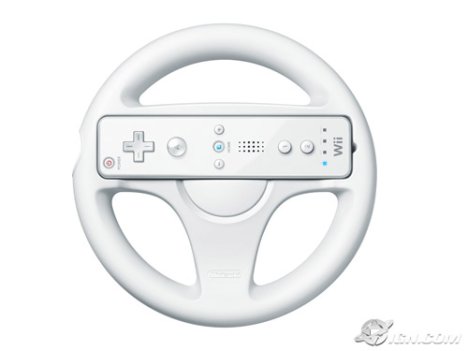
For the Wii alone I seem to have collected two wimmotes and nunchucks, at least one plastic guitar (two if you count the one I've borrowed from the department), a Mario Kart steering wheel and four GameCube controllers (that I seem to have acquired on long term loan). The funny thing about Mario Kart is that I found the the steering wheel to be the most difficult choice of controller. Playing it with a group of friends the other week, it seemed like the more traditional GameCube controllers were easiest, though one us seemed quite happy using the Wiimote and nunchuck combination. Maybe it's because the older controllers are just the ones I've had more experience with, but it still seems a little odd that the option that appeared to be the most intuitive, wasn't in practice. I just don't get what the advantage was supposed to be, and considering it's essentially a bit of plastic you just stick the Wiimote in, I'm not going to be buying any extra ones for my friends.

You see, besides the issue of where you are supposed to store all this equipment, it's also worth asking how you are supposed to pay for all of it? Nintendo are really pushing their periperals - for the Wii, you can get a Sharp shooter, a Light Sword and tennis rackets to name but a few. With things like the Zapper that comes with Link's Crossbow training, it's not even clear whether you'll be able to use the peripheral for anything else. Further, it's a little confusing which controllers you can use with what games as there is also the Classic Controller and the option to download retro games through the Virtual Console.

As consumers, are we really expected to buy every add on we can get? I think what really annoys me about the whole thing is how much emphasis companies like Nintendo have placed recently on the social side of gaming but at the same time they only provide one set of controllers. Plus, it's not exactly cheap get the set of four (don't forget you need a Wiimote and a Nunchuck) that would allow you to take full advantage of multi-player gaming. I'm pretty sure the same is true of the PS3 and Xbox 360 as well. Anybody else remember the days when you could buy a Sega MegaDrive with two control pads?

Monday, 26 May 2008

On the Rain-Slick Precipice of Darkness: Episode One (PC)

Ok so I'm not sure if this counts as a seventh generation game as such, but it has only just been released and I did really enjoy playing it so I'm going to write about it.


Created by Mike 'Gabe' Krahulik and Jerry 'Tycho' Holkins from Penny Arcade, in conjunction with Hothead Games, On the Rain Slick Precipice of Darkness allows you to enter the 1920s world of New Arcadia. After a bit of a random intro sequence where your house is crushed by a giant robot, you get to join Tycho and Gabe as part of their Startling Detective agency in order to figure out just what is going on. Then you're off of on an adventure involving Tycho's niece Anne Claire (who has been recast from the comics as some sort of scientific/engineering genius), battling various hobos, robotic 'Fruit Fuckers', clowns, mime's and barber shop quartets with your trusty rake, exploring Desperation St, Hobo Alley and Pelican Bay on a quest that will ultimately involve destroying a god.

It's all a bit random and thoroughly enjoyable because of it. It reminded me of when I used to play Lucas Arts games like the Monkey Island series, and Grim Fandango, which is not surprising given Ron Gilbert's involvement in the project (he helped create the first two Monkey Island games). Partly this was due to the look and feel of it, but also because the game has a sense of humour. It's funny in that 'it makes you smile' kind of way because it treats you as someone who gets the joke. Maybe it helps to be familiar with the characters from the web-comic, or the tongue in cheek humour of Monkey Island but I'd like to think most people would appreciate this is not a serious adventure game. It seems that some of this will depend on whether you do get the in-jokes or not, which in turn depends on what knowledge you bring into the game in the first place. I wonder whether the role of humour has been examined with respect to games and learning? Is it really just another way of making things fun or does it have a more fundamental role to play?

Another familiar aspect of the game was it's player friendly design. It's very hard to die, but if you do the consequences are pretty much negligible. Plus, you can save whenever you like. The combat scenes may seem a little confusing at first, especially getting the hang of each character's special moves, but you quickly get used to the turn based combat and rolling of the 12 sided dice, and start to enjoy the amusing fight sequences that often ensue. Oh, and you can pick up various exploding items, power ups and downs during your travels that can aid you during a fight. Then there is the Detective Agency screen where you can examine case logs, check your inventory and look at the files which contain info on pretty much everyone in the game.

The language in the game - fighting Fruit Fucker robots and looking for somewhere to live in the Shithole - and it's M rating makes it clear has not been aimed at a young audience. There are also pools of blood in certain areas, and a subplot involving the selling of hobo meat to a charity worker (which sounds a lot darker than it is and the hobos attacked us first - honest!). However, it's not supposed to be a disturbing game, so you also get mime's fight moves like 'pretending to throw a grenade' and clown's blood that looks like paint, which means you get fight scenes that end up looking like an over enthusiastic round of paintball. The humour might be a little dark in places, but I guess I quite like that.

Most of the time you do feel like you are running around inside a 1920s comic book world of robots, the occult, while meeting some very odd individuals in the process. The look and feel of the Penny Arcade comics are especially preserved by the polished cut scenes. But there were a few glitches that need addressing. There were silly things, like the fact one of my eyebrows always appeared in front of my hair in the cut scenes. There were also more annoying things like needing to click on an object three times before my character would actually go to it. Then there was the most annoying thing ever - during the final battle, if you called the cat (T. Kemper from the comic) to perform a supporting character attack, the game crashes and you have to start the battle again. So I hope they figure this sort of stuff out by the next installment.

See the other thing about the On the Rain Slick, is that it is an episodic game. That means it's short. Short enough, and entertaining enough, for me to finish within a few days. There is something about this that appeals to me as it means the game is broken down into distinct yet manageable chunks which I stand a chance of completing. However, it will probably end up costing me more as I will have to buy and download the rest of the episodes from Greenhouse Studios. Worst of all though, I now have to wait four months for episode two.