Showing posts with label wii. Show all posts

Thursday, 30 September 2010

Sam & Max and my research

Again, it's been a while. I have the excuse of spending the last few months running my main data collection study, though I have also been playing games throughout. Maybe I've been quite busy, but maybe I also haven't felt like I've had a lot to say. Recently though, I've been thinking more and more about one particular series I've been playing and how I got back into it after being convinced to give it another go as a result of one of my data collection sessions.

Over the past few months, I've been asking participants to keep a set of gaming diaries and to come into the lab we've set up in the department to play games. They had to keep the diary for three weeks and come in on three seperate occassions so I could hook them up to various physiological equipment (to measure changes in muscle tension, galvanic skin response and heart rate) and observe them playing games. The sessions lasted about 2-3hours so all in all it was quite an investement from them. Even when all I could offer was a Amazon voucher just to say thanks, 9 people actually agreed to take part and for that I am very grateful :-)

Anyway, during the first two sessions I would ask people to bring in a game of their choice, preferably something they'd been playing. But for the final session I would pick a game for them. For my first participant - who is also a friend of mine but for the purposes of anonymity, let's call him Matt - I chose Sam and Max: Save the World . It's a point and click type adventure, with lots of puzzle solving where you play Sam and Max who Wikipedia describes as "self-styled vigilante private investigators, the former an anthropomorphic dog and the latter a 'hyperkinetic rabbity thing'" as they set about uncovering a hypnotism conspiracy.


I picked the game up ages ago for the Wii and though I played for a bit, I got stuck at one point early on and just never went back to it. I'm going to be honest here, while I wanted to choose something Matt hadn't played before (and that contrasted in pace to his own choices - survival horror/FPS), I also chose it because I thought he would find it boring. And I wanted to see whether all that physiological data I've been collecting would reflect that. I'm still working on the data so I'm going to have to save the in depth analyses for later on (and hopefully publication...) but he didn't find it boring. He liked it. That didn't mean he wasn't frustrated by some aspects of it, but he seemed to enjoy it. What really surprised me was that him liking it made me want to try it again. So I did, and I finished it this time. And then I bought the next series, Beyond Time and Space on Steam (because it wasn't on the Wii) and finished that. And then I played the latest series The Devil's Playhouse, and had to wait for Telltale to complete the last two episodes so I could finish that too.

So what happened? Why did I write the game off only so soon? What made me go back to it? How many other games do I have that I never really gave a fair shot? Looking back, I remember wanting to like Save the World but getting a little annoyed by all the dialogue and getting impatient with some of the puzzles. Even though I did think it was funny, I guess I didn't think it was funny enough to keep playing. So when I got stuck, maybe it didn't feel like there was enough incentive to go back. It was a good couple of years ago now when I got the game so I can't say for sure, but I also imagine that I got distracted by other games that I had at the time. So I forgot about it, until I started my study and had to come up with games for other people to play. That's already going to put it back on my radar, but then Matt seemed to enjoy it and we talked about it afterwards, and it made me want to give it another go. I think the fact that we are also friends who talk about games has something to do with it too. Though I don't think he's played the game since, him playing it in the session made me feel more like a shared experience, and when I refer to the series he knows what I'm talking about. Could that alone have increased my involvement with the game? I think it might have. And I'm glad it did.

I'm not saying it's a perfect series. Like most point and click adventures, the puzzles are less about creative problem solving and more about trying to figure out how the designer wants you to solve it. The dialogue is funny, but there is a lot of it and the story doesn't always really make a whole lot of sense... It was ok playing it with the Wii controls but the later games weren only out on Steam so I had to switch. I think the second game, Beyond Time and Space was the weakest of the three I played - it felt rushed, shorter than the others, with puzzles that made even less sense than normal. But the more I played, the better I got at it (and yes I did sometimes resort to walkthroughs or increased the in-game hint level, but I noticed as time went on this happened less too). Maybe I learnt how to think like the designers, but the puzzles didn't feel as frustrating. So even if the narrative was a little out there, I kept progressing, and I still wanted to know what was going to happen next. But I needed a reason to get past the initital hurdle I came across and that seemed to come from sharing the experience with someone else. Without them even being in the same room! And now it's got me wondering what other games I would have enjoyed? Also, I'm wondering what I would have given up on if I hadn't had others to share the experience with?!

All of this ties in with my reseach because I'm not just interested in what happens when we play but why we choose to play anything in the first place. Like I said, the analysis is at a pretty early stage but if I can uncover at least part of that, and explain how it all might relate to learning, then I might just have something decent to put in my thesis ;-) Plus, it's something I need to consider when I am doing my analysis - if my participants had an impact on my game-playing, then how did I impact theirs?

Monday, 9 February 2009

Social gaming

I had a couple of friends come round last weekend so we could have a go on a some games I'd been wanting to try out. The first one was World of Goo, which I already knew I was going to love as I'd already played the PC demo. At first we were looking for some sort of multi-player mode, but then realised that all you had to do was point another wiimote at the screen to join in the puzzle solving. World of Goo is seriously easy to pick up, and we enjoyed it pretty much from the start. It follows the usual approach of starting you off with relatively easy tasks which get grow more and more difficult the further you progress - achieving a nice balance between your developing skills and the challenges you have to face. I also really like how you gradually start to become more and more curious about the goo and what exactly is going on in the game world. Who is the mysterious Sign Painter who leaves cryptic clues around the place? What are goo balls used for? What's with the random giant frogs? And so on. While I quite like this sort of randomness, one of my friends did point out the self-referential humour employed by the game might get annoying after a while. It was quite interesting to try and solve each puzzle with someone else though, especially since the experience seemed to have much to do with who you are playing with! While it made sense to cooperate and establish some sort of strategy together i.e. "you do the bridge and I'll do the balloons" (see image below), there was also the occasional competitive moment of "stop stealing my goo balls!". We didn't try it with three wiimotes but I have a suspicion it would have been quite hard to break down the puzzles into different tasks and it would have just turned into who can solve the puzzle fastest!


In contrast, de Blob supports multi-player play with a party gaming mode. The game is essentially a single-player adventure where you have to bring colour back to Chroma City by acquiring paint and bumping into things. It's amusing enough but not very engaging in the long term to be honest - I think I'm more intrigued by World of Goo's Sign Painter than the de Blob story. I had hoped the party mode would be a bit more interesting, but it essentially consists of three mini-games (which you have to unlock by playing the story mode) where you can compete against another player (actually up to 4, but while I do have 4 wiimotes, I've only got two nunchucks). The image below shows the split screen for two-player mode. We played it for a bit and it was entertaining but to be honest there wasn't much there to keep us going for long. The party mode just ended up feeling like a bit of a simplistic add on thrown in to try and tap into the Wii's success as a party console. Which is fine, if you don't want to invest much effort into it, or if you're playing with people who don't have much gaming experience.


If you want something a bit meatier though, there is Little Big Planet on the PS3, which I would seriously encourage anyone to have a go on. I'm going to ignore the user-generated content side of things for the moment as I think I want to do a separate post on this later on, and focus on the going through the levels, which you have to do anyway to unlock materials to design your own levels. I have played it on my own, and while it's incredibly cute and you could spend ages customising your little sack person, I found it a lot more fun to play it with someone. I first tried it back home at Christmas with my sister, and it brought back memories of how it used to feel playing together on my Mega-drive as kids - a sort of nostalgic bonding experience! The game encourages you to play with someone else by providing challenges you can only solve with the help of another player. I didn't realise until I was helping out at the Digilab stall in the Learn About Fair on campus a couple of weeks ago that you can play with up to four players. This was quite cool in terms of getting as many people to try it as possible but did get a little complicated trying to keep multiple sack boys and girls on screen at once (if your character disappears off to one side for too long you end up losing a life).


So, I think two-player mode works best, but while the game starts out easy enough some of the later levels can be quite difficult! Or at least they require a level of coordination and timing from both players that isn't always easy to achieve. The fact that there are frequent save points throughout each level means reduces the consequences of falling off a cliff or into crocodile jaws, being burnt to death etc but you essentially get four chances at making it to the next checkpoint, and that's between the number of people playing. So if there are two of you, and one of you has died twice, and the other once, the pressure is on for the second player to make it to the next check point in one piece, otherwise you have to go back to the start of the level It's an interesting mechanic, but it can get a little frustrating when things don't go very well. Plus, I tend to want to rush into everything when presented with a new level (I'm going to blame this on growing up playing Sonic...) when perhaps a bit of patience would work better. I also think that while de Blob and possibly World of Goo could quickly be picked up by any player, and played quite happily by a single player, Little Big Planet requires a bit more investment from two people to really reach it's potential as an engaging platformer. At the end of the day, I guess what you choose what you want to play based on the energy you want to put in and the experience you want to have.

Tuesday, 23 December 2008

Overdue games update

I'm on a break for the holidays so thought it was about time I wrote something about what I've been playing over the last couple of months. I've left Spore off this list as I've only recently gotten in to playing it again and want to post about it in more depth later on.


Since September, I've managed to complete two games. The first is episode two of the Penny Arcade Adventures: On the Rain-Slick Precipice of Darkness (PC version) developed by Hothead Games. You join Gabe and Tycho again on their quest to find the giant robot destroying New Arcadia (and which destroyed your house in the first episode). Basically, it was more of the same as the first episode but I'm not convinced it was quite as fun. At least in terms of the turn-based combat, I got more out of the mimed attacks and colourful clown blood spatter, than I did of beating up rich snobs and mental patients (cue ethical discussion here...). I did enjoy it though, because of the humour that comes with it and I think I quite like the episodic format - it doesn't take more than a few hours to complete. I also think I'm driven more to complete games like this by a desire to get to the end of the story than by a sense of challenge, as I'm not sure I want to go back and do it all over again in "insane mode". I mean, you'd have to promise something a lot more than the same thing again but a hell of a lot harder.


The second game I completed was Lost Winds, developed by Frontier Developments for the Wii. Available on WiiWare (as opposed to in shops) where you play Toku, a young boy who has to save his homeland from the elemental spirit Balasaar with the help of the Wind spirit Enril. You control his movements with the nun-chuck but also use the Wiimote to control the wind in order to help Toku jump higher and further. Apparently a second player can use an additional Wiimote to help Toku jump further but not higher (similar to the co-op mode in Super Mario Galaxy) but I haven't tried it. I really enjoyed Lost Winds, again because I could complete it in a few hours (as opposed to weeks) and also because it is one of the few games I've come across that actually integrates how you use the Wiimote into the story and gameplay. It's also easy to pick up and very pretty. It might be a little too short (I think it might be best to think of it as an episodic game, as a sequel seems to be in the works) and it could definitely have benefited from a map, or some sort of spatial representation of where you were and where you could go, since I seemed to spend a fair bit of time retracing my steps. If you have a Wii though, I would definitely recommend downloading it and it is only 1000 points (only £7).


I've also been playing a point-and-click adventure game called A Vampyre Story about an opera singing vampire named Mona who was kidnapped and turned into a vampire by the rather pathetic Shrowdy von Kieffer and is now trying to escape back to Paris. Developed by Crimson Cow I had high hopes for this as I'm a big fan of the genre and while it looks pretty, I'm finding the characters a little annoying, especially Mona's sidekick Froderick the bat, and the dialogue you have to sit through can be a little tedious (and just isn't that funny). I'm not sure the interface works that well either and in general I'm just not enjoying it as much as I thought I would. I think it might go on the back burner for a bit while I play Spore...


Lastly, there is World of Goo developed by independent games studio 2D-Boy. I played the PC demo a while back but have been waiting for it to be released on WiiWare in Europe - which should be soon - to see what it's like on the Wii. I absolutely loved this game. Described as a puzzle/construction game by it's developers, the player controls balls of goo which you can attach in different ways to form bridges and structures so the remaining goo can exit the pipe (a bit like Lemmings). It's not only easy to learn, but also clever and engaging. But if I have to wait too much longer I think I'll end up with the PC version.


Ok, think that's it for now at least!

Friday, 6 June 2008

A bit of a rant about controllers and peripherals

Chris Plante posted an article called "Problematic Peripherals" about all the extra kit that seems to come along with games these days. He's got a point - where exactly are you supposed to find space to put it all? And what sort of place are you supposed to be living in to have space to play things like Wii Fit or god forbid, Rock Band?

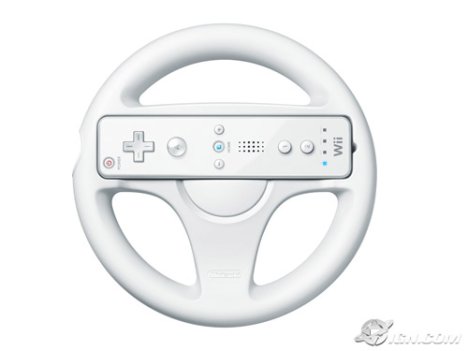
For the Wii alone I seem to have collected two wimmotes and nunchucks, at least one plastic guitar (two if you count the one I've borrowed from the department), a Mario Kart steering wheel and four GameCube controllers (that I seem to have acquired on long term loan). The funny thing about Mario Kart is that I found the the steering wheel to be the most difficult choice of controller. Playing it with a group of friends the other week, it seemed like the more traditional GameCube controllers were easiest, though one us seemed quite happy using the Wiimote and nunchuck combination. Maybe it's because the older controllers are just the ones I've had more experience with, but it still seems a little odd that the option that appeared to be the most intuitive, wasn't in practice. I just don't get what the advantage was supposed to be, and considering it's essentially a bit of plastic you just stick the Wiimote in, I'm not going to be buying any extra ones for my friends.

You see, besides the issue of where you are supposed to store all this equipment, it's also worth asking how you are supposed to pay for all of it? Nintendo are really pushing their periperals - for the Wii, you can get a Sharp shooter, a Light Sword and tennis rackets to name but a few. With things like the Zapper that comes with Link's Crossbow training, it's not even clear whether you'll be able to use the peripheral for anything else. Further, it's a little confusing which controllers you can use with what games as there is also the Classic Controller and the option to download retro games through the Virtual Console.

As consumers, are we really expected to buy every add on we can get? I think what really annoys me about the whole thing is how much emphasis companies like Nintendo have placed recently on the social side of gaming but at the same time they only provide one set of controllers. Plus, it's not exactly cheap get the set of four (don't forget you need a Wiimote and a Nunchuck) that would allow you to take full advantage of multi-player gaming. I'm pretty sure the same is true of the PS3 and Xbox 360 as well. Anybody else remember the days when you could buy a Sega MegaDrive with two control pads?

Tuesday, 29 April 2008

Endless Ocean (Wii)

I've recently had a look at Endless Ocean on the Wii, and it's proved to be an interesting change. First off, it manages to put you into some sort of trance like state by making you feel like you could actually be underwater (whilst somehow managing to keep dry). The graphics are obviously key to this experience (and perhaps playing it on a 32inch TV) but I think the music is quite important too. Tycho from Penny Arcade puts it well when he writes: "The rhythm of the scuba gear itself is sufficiently hypnotic, but they offer up musical selections in parallel: there is a warbling sea witch in this game whose voice can drown men. When we dive, I believe we dive in search of her." As you progress in the game, you can unlock further similar tracks but you can also play music of your own from an SD card you can plug into the Wii. It is probably best to find something more chilled out to swim around too though as the game is so relaxed it might be a bit disconcerting to have Arctic Monkeys or something in the background.


It's also different because I'm not sure what the goal is. You seem to get to dive and swim around and poke fish, a lot. I've also managed to become a freelance photographer, get hold of an underwater pen, and make a dolphin my diving partner, who I have (very originally) called Ecco. This might sound busy, but it's not really. It's all the less stressful because there is no competition, no an enemy to fight, no point system as such or and there's not even a time limit. Of course there is a story line - I've been hired as some sort of researcher/diving guide to work on a boat with this lady called Catherine who can't swim and seems to have some sort of issue with her father (I caught her making apologies to him while staring out to sea), but it doesn't seem very important. At the end of the day I can choose whether to take people on tours or not and I seem to be able to decide where I want to go, with a few hints from Catherine about where might be interesting. There are also hints of legends about caves and the like but at the end of the day I can just sit on the deck and watch the sea.

Admittedly all this relaxing gets a little boring so it is quite nice to go on dives. You can catalog all the sea creatures you find by following them aroun and you seem to be able to find stuff out quicker if you feed, poke or stroke them. That's one of the ways you seem to progress in the game, by discovering new species. The other indicators are: adding more information to existing species, exploring new areas on the map, and feedback concerning you guided dives. For my last diving tour I got an A, I think because I actually managed to find the fish the client wanted to see. But it's still all very relaxed. There is the occasional moment of frustration though when waving the Wiimote doesn't quite get your avatar to do what you were expecting it to do. Plus, I'm not sure whether I've forgotten the controls for looking more closely at something and picking up objects, or if there are just some things I have to wait to be unlocked before I can do so.

You'd think I might have learnt a bit more about different kinds of life underwater but I'm not sure I have. I don't really read the information I gather, and very little of it seems to stick. That said, I never knew there was such a thing as a False Killer Whale but apparently there is. In fact, the information you get is rather like skimming through an article in wikipedia and then forgetting all about it. I'm not sure about this poking and stroking fish thing either. I mean, is that really the best strategy to use when faced with a species you've never encountered before? Especially when it looks like something that might want to bite or poison you. It seems impossible to die in this game as you don't even seem to be able to run out of oxygen. Not that I want to die, but it seems odd there is no element of risk at all. Maybe it's just a result of playing other games, but I can't help expecting something bad to happen at some point.

I find it interesting that I care about things like the feedback I got from a dive, and how many creatures I've found, but that I don't really care about what I've actually found out about them. I also don't care about Catherine's relationship with her father (for all I know she blames him for never teaching her to swim). I do think the game engages me emotionally, but only when I'm actually diving. So when I'm swimming underwater, the music is playing and there are pretty fish and coral to look, it feels good. It's a nice change from trying to kill all the baddies and trying to improve your performance all the time. Though you can get a bit of a shock bumping into a particularly ugly fish, or something large like a manatee. I don't think that feeling of being immersed under water is the same as experiencing of flow though, mainly because the game seems to lack any real sense of challenge. So, I doubt I'm going to be playing much more of it as I'm just not sure what I'm getting out of it, and trying to discover every single species doesn't seem enough to keep me playing on the off chance that something else will happen.

Monday, 24 March 2008

An awful lot of gameplay and a few thoughts

I've been playing quite of different games lately and have been struck by a couple of things. The first concerns the fact that I haven't actually gotten round to finishing any of them. Which links in quite nicely with Leigh Alexander's article on "Completion Anxiety Disoder" where she considers the reasons why people don't seem to end up completing many of the games they actually have. She covers lots of practical reasons like not having enough time, and games being too difficult/easy or not interesting enough and then ends up suggesting a further reason; that players sometimes just don't want the game to end. Now it's a pretty interesting article in itself, but when you think about it in terms of how this relates to the educational potential of games it raises a couple of interesting issues. I mean lets assume we're talking about good games here, the ones that do get the challenges right and manage to maintain our interest, she's still basically saying that even when the motivation to play is there, people don't actually want to finish what they started. This would mean an end to the game-play experience and so instead it appears better to just avoid playing. So, if we're thinking about games as learning environments, then doesn't that mean that those playing won't get the 'complete' learning experience? Maybe this is only an issue if you think about learning in terms of delivering content and achieving outcomes? Or maybe it's just an odd claim to make, especially when you think about comparing it to not finishing a book or a film. In those cases, the only times I don't are when I'm not enjoying the experience - if I really enjoy it then I usually end up reading/watching it again, rather than trying to avoid the ending all together.

The other thing I've been thinking about has to do with playing Guitar Hero III and how frustrated I got with it when trying to beat Slash in a guitar battle and I couldn't. It really pissed me off. Which didn't exaclty help me when trying to concentrate on getting the notes right, so after suppressing the somewhat rock star urge to smash the tv with the Les Paul controller, I turned if off. Don't get me wrong, I really did enjoy playing and still do - I think it's been a while since I've really felt that sort pure sensation of 'flow' - but only when I'm good at it. It made me think though about all the things I've been reading about learning and fun. I kind of realised that I'd forgotten that just because you enjoy learning something doesn't mean that it's easy. I suppose the point of the story is that I did go back and beat Slash, which felt good, and so I'm still playing it. But if I want to be really good at Guitar Hero, it looks like I might actually need to take the practice mode seriously (where you can practice the songs you unlock outside of career mode). I just can't help feeling that if I'm going to do that, then maybe I'd be better off picking up the rather dusty bass guitar I got a couple of years ago and practice on that instead so I can learn to actually play along to the all songs I've been enjoying in the game.

Monday, 10 March 2008

Lego Star Wars: The Complete Saga (Wii)

I borrowed Lego Star Wars from Lovefilm a little while ago and have been really getting into it. I did have a slightly rocky start as it took me a little while to realise that the cantina I started in wasn't a proper level even though you could explore it and start fights with people. I eventually found the set of doors where you get to pick which part of the saga (i.e. episodes 1-6) you want to play. While not having a manual probably contributed to my initial confusion, it wasn't a problem in terms of the controls as I found it was very easy to pick up them up. One of my favourite discoveries was being able to use the z button to build stuff out of seemingly random bits of Lego, and finding out I could "use the force" on objects and characters with a blue glow around them. Plus, if your character has a sword you can swing the Wiimote to use it.

The initial appeal of the game I think for me was how it manages to combine two very familiar things in an entertaining way. Lego Star Wars looks good. I was walking past the Lego store in town the other day and I actually thougth about buying something. Plus, I know these films, especially the ones I watched as a kid, so I don't need to hear the dialogue to know what's going on in the story. It's far more enjoyable to see the Lego characters mumble and shrug while they act out classic scenes. Even better, you seem to get to be able to play all the characters at some point, unlocking more as you go on. While you can swap between a certain set in each level e.g. Obi Wan, Luke, C3PO and R2D2 in some of the earlier ones, once you've completed the challenges you can go back with any unlocked character and do the level again in free play mode. In fact, if you want to unlock hidden areas and collect everything it looks like you have to go through them all again. I wonder if this is enough incentive to do so?

That is one of the things that struck me about the game - it really feels like it's about collecting stuff. I mean of course there is the Star Wars plot and the associated challenges (rescue the girl, kill the baddies, save the world etc) but the game is really arranged around how much of what you collect and whether you have achieved "True Jedi" status on every level. I mean it was obvious from the start that you should collecting the large numbers of gold, silver and occasionaly blue studs - which are either lying around or you get from building/destroying/using the force on object. What is more interesting though is that I wanted to collect them, and collect them all if I could. I mean there are hundreds of these things, and when you destroy somethinng they fly out at you and you don't always have enough time to collect them all (which is a little annoying especially when they also spill over a ledge you can't jump down). At first I thought you needed them to buy things at the cantina. Then when I started episode one I noticed the bar at the top which started to fill up the more studs I collected. If you get enough you achieve "True Jedi" status. I still don't quite know what that means but you get a little tick at the end of the chapter if you achieve it. Td how many of the golden bricks, and mini-kits you have found and how many are left for you to discover. And I want them all, even though I'm not sure what happens if and when I manage to do so. Part of the incentive is that further aspects of the game will be unlocked in the process but I doubt that if I did manage to collect everything the outcome would be as exciting as I feel it should be. The main point though, is that the way the game has been designed means it's not just about getting to the end of each level, but it's also about exploring the entire game to unlock each section.

It's a little similar to playing Super Mario Galaxy and having the desire to collect all the star bits. I was talking to Will the other day and we agreed that we hate it when we're watching someone else play and they don't collect really obvious ones. I can't help thinking that this collecting aspect means Lego Star Wars comes across as more of platform game than an action adventure one. For example, in Zelda you do collect gems but the purpose of them is so you can buy other things that are useful to your adventures like better armour and weapons, or oil for your lantern. In contrast, in the Sonic and Mario games you collect gold (rings and coins respectively) but just to see how many you can get. Things like star bits, studs or gold coins aren't even power ups as such, at least not until you collect enough of them and get an extra life or something. Is that enough of an incentive to explain the drive to pick them all up? Something else seems to be going on here but I'm not sure what.

Monday, 21 January 2008

Co-located play (or Playing games in the same room with friends)

I've been thinking a bit lately by how social games have become. I mean, they've always had a social side, but they've become a lot more socially 'acceptable' over the last few years. And I don't just mean the rise of the MMORPG, like World of Warcraft, but the more traditional inviting people round to play. I know with respect to the Wii, the novelty factor is responsible in part for this curiosity, but can it last? Can the Wii introduce people to gaming and keep them interested?

I was playing a couple of games at my sister Katerina's over the weekend. She's never been seriously into games but enjoys playing them with people. One of the games we looked at was Super Mario Galaxy. I wanted to try out the co-star mode where you have one player playing Mario, and the other acting as some sort of helper, and we took turns in different roles. The second player uses the Wiimote to do things like collect and shoot star bits, freeze enemies, make Mario jump higher etc but you don't actually play a second character (like in Sonic 3 on the Mega Drive for instance, where you can play Tails ). I didn't mind being the 'co-star' as it was pretty interesting trying to anticipate what player 1 was going to do next and figuring out how you could help out. Plus, I'm sure there were a couple of points where my actions e.g. freezing an enemy mushroom, dictated what player 1 actually did do next. In contrast, my sister got a little bored after a while. We only played the first couple of levels, so it's possible it would have got more interesting as the levels got more complex. Meanwhile the endless storyboarding at the start of the game (which you unfortunately can't skip) probably didn't help either. Nevertheless, I can see how you could get bored just pointing the Wii remote at the screen for hours, while someone else actually gets to play the game.

We also played EA Playground, a game that revolves around a number of different playground games e.g. dodge ball, track car racing, tether ball etc. There were three of us playing but we only had two Wii remotes, so we ended up taking turns. It would have been interesting to see how the games would have dealt with more than two players, as I'm not sure they all could. There was a bit of a learning curve as each game had it's own set of instructions that we had to read through, but since there was some crossover between games it wasn't too bad. What was annoying was the tiny writing the instructions were displayed in. One of the things we noticed while playing was how in some games e.g. tether ball, you could quite easily strain your arm. Ok, so part of this is due to getting a bit excited waving the Wii remote around (which also tends to something getting knocked over) but it must have something to do with the feedback from the game. This came up in a meeting with my supervisors a little while ago when we were talking about Wii Sports (the gameplay in Playground is pretty similar to this). We talked about how the feedback from the remote is not the same as you get in real life when performing the same actions. The fact that you don't 'feel' the ball when you hit it seems to make you more likely to try and hit it harder. Since there isn't actually anything there, you just end up straining yourself. If the Wii is trying to tap into 'natural' movement, this could end up confusing the learning process when you realise it's not quite the same as in real life.

We did enjoy playing Playground though and I reckon this was because it is set up as a number of different competitions. You can play in the same team for some of the games, but the goal is still to win. Super Mario Galaxy requires a lot more investment in terms of time, and is not so easy to dip in and out of. So for what we wanted - to spend an hour or two playing games - we were much better off with something like Playground where we could try out different games that were relatively short and had clear cut goals for each of them. I think it might be quite difficult to find a dedicated co-star to play Mario with over long periods of time. In contrast, the single player mode in Mario is probably a lot more interesting. Though kids can play both games, EA Playground comes acorss as a bit more simplistic and with less to explore than in Super Mario Galaxy.

I guess it partly comes down to what you want to play games for and to everyones' personal preferences. It seems to be the case that when it comes to playing a game with a group of people, you don't want something with a high learning curve that requires a lot of investment. What seems more popular are games where you can compete against each other, or a computer controlled team, and that you can play in short bursts (or longer if you so choose). So far, the Wii seems to be catering for both the dedicated single player and the more casual group of multi-players.

Wednesday, 28 November 2007

Trauma Centre: Second Opinion (Wii)

I borrowed Trauma Centre from the department, and was looking forward to trying it since it looked like it was really going to let you make the most of the Wii Remote. Plus, cutting up people and trying to stitch them up seemed like it should be fun. The game took a little while to get going since it was introducing the characters which seemed fair enough at the time. You play this sort of inept new doctor, who essentially depends on a more experienced (young, pretty, female – big surprise) nurse to guide you through your first couple of operations. This seemed to be a pretty good way to introduce you to the controls and sequences you have to go through, especially in my case as for some reason the dept has the German version of the game (its in English but the manual isn’t) so I had no idea what I was doing at first. I managed to kill my first patient straight away, by not realising I had to put the glass shards I tweezed out on a plate on the side of the screen and lowering my patients vitals pretty quick. The music definitely adds to the tension, as does the time limit and the fact the nurse keeps calling out “doctor!” – making think I’ve done something wrong when she is just telling me what I should do next.

So anyway, after my initial failure, I started to get the hang of it. The operations were fun, and I seemed to pick up what I needed to do without really realising it. This was something I noticed when I got a new nurse (also female, younger and possibly prettier but definitely less helpful) and had to figure out what I needed to do when on my own. Some of the tools were easier to use than others, for instance I quite liked the scalpel since you just had to wave the remote in a relatively straight line but had trouble with suturing as it took me a while to figure all I needed was a zig zag motion across the wound. There were some tasks though I had real problems with like using the defibrillators, and learning how to draw a star so I could activate my healing touch (more later on this). The game threw some medical terms at me, some of which may have been real and as you go on, some which were definitely not. But you didn’t seem to need much of this information to do the actual operations so I didn’t care too much.

I also didn’t really care too much about the narrative – in part at least because it was all scripted and I had no control over my character, who I didn’t really identify with, and because it all seemed a little silly. You have to play this inept doctor (even if you do get given an A at the end of all your operations), who goes on to discover he has the “healing touch” (an ability passed down from the ancient Greeks which allows you to slow down time during operations when you play Derek or helps increase a patients vitals when you play the Nozomi sequences) and is actually the only one who can defeat the GUILT virus. I laughed out loud when I first came across the GUILT virus, I thought for a minute it might be some horrible disease you get when your conscience has had enough but no apparently it stands for the Gangliated Utrophin Immuno Latency Toxin virus. And it looks like terrorists are to blame for it. Uh huh.

Trauma Centre is a fun game, and does utilise the Wii Remote and nun-chuck in pretty cool ways. It also manages to teach you how to use them without you having to think about it too much. The operations themselves are addictive; you did want to keep trying until you got the hang of a new tool/sequence (or until your patient didn’t die). You do want to get an A as opposed to C rating at the end of each one. Oh, and it helps you can change the difficulty rating at each operation. But the storyline didn’t really work for me. I started to lose interest and grew bored of having to click through seemingly endless storyboards (Which Will did mention when I borrowed it). I didn’t care about the characters, or the GUILT virus, I didn’t want to find out what was going to happen next. It all came across as a little ridiculous – surely we have enough diseases in the world without having to resort to made up terrorist ones – while it also treated issues such as suicide and euthanasia simplistically be resolving them in really cheesy ways. Any experiences of flow were definitely limited to the operation mode. Ultimately, it wasn’t emotionally engaging enough and I felt the story was getting in the way of me doing what I actually wanted to be doing.